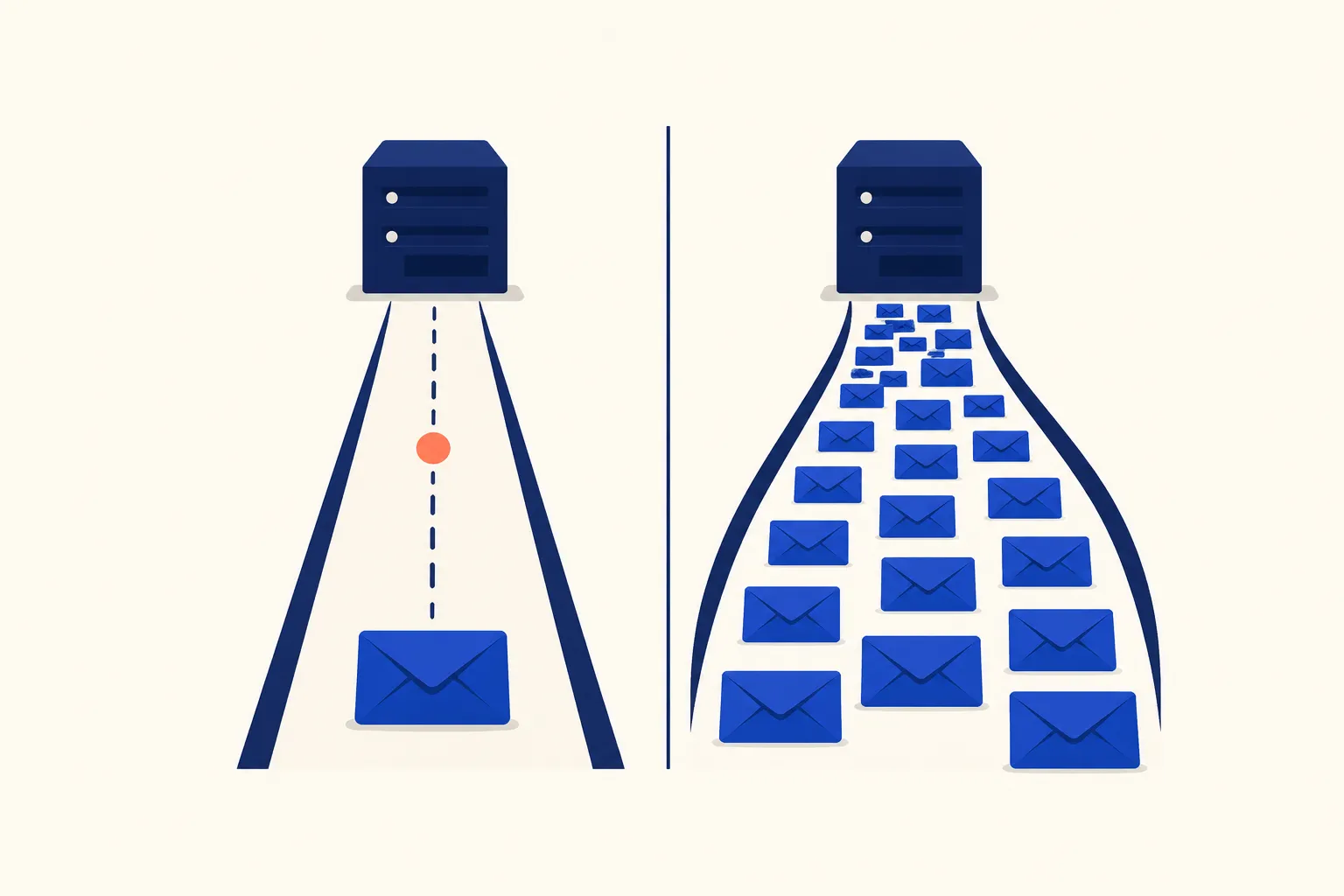
Whether a dedicated IP or a shared IP is right for your sending comes down almost entirely to volume and consistency, not to which option sounds more professional. A dedicated IP puts your sender reputation entirely in your own hands: no other sender’s mistakes can drag it down, but you also have no history to lean on until you build one through a warmup ramp. A shared IP pool, run by your ESP, arrives pre-warmed and benefits from the aggregate reputation of everyone sending through it, at the cost of being exposed to their mistakes too. Most SaaS teams sending under roughly 50,000 emails a month are better served by a shared pool. Above that, and once volume is steady from month to month, a dedicated IP starts to earn its cost and warmup burden.
Shared and Dedicated IPs Track Reputation Differently
On a shared IP pool, sender reputation is judged at the pool level. Amazon SES describes shared addresses as ones where several customers’ mail is combined and “AWS carefully manages the outbound traffic to maximize the reputations of the shared IP addresses.” Your individual sending habits barely register against that aggregate, for better or worse: a clean list gets a lift from established neighbors, but a neighbor running spammy campaigns can drag the pool’s reputation down along with you.
A dedicated IP flips that arrangement. Per Amazon SES’s dedicated IP documentation, “your sender reputation is completely under your control. Your SES account is the only one that is able to send email from those addresses.” That isolation is the entire point of paying for one: no neighbor can hurt you, but no neighbor can help you either. A brand-new dedicated IP has no history at all, so mailbox providers scrutinize every message from it until consistent sending proves it deserves trust.
Dedicated IP vs. Shared IP at a Glance
| Factor | Dedicated IP | Shared IP |
|---|---|---|
| Reputation source | Built entirely from your own sending history | Pooled with every sender using that IP |
| Warmup required | Yes, a gradual ramp before full volume | No, already warmed by the provider |
| Volume guidance (varies by ESP) | Roughly 50,000 to 300,000+ emails/month | No practical minimum |
| Consistency requirement | High: irregular sending damages reputation | Low: bursty or seasonal sending is fine |
| Exposure to other senders | None | Yes, a neighbor’s bad practices can affect you |
| Added cost | Per-IP monthly fee on top of your plan | Usually included in the base plan |
| Best fit | Consistent, high-volume senders wanting full control | Most SaaS teams below high volume, or inconsistent senders |
The Volume Threshold: How Much Sending Justifies a Dedicated IP
ESPs do not agree on an exact number, but their guidance clusters in the same range. Postmark recommends “sending at least 300k messages a month to be able to properly maintain a dedicated IP,” and notes that below that level “there’s no need to go through a warming-up period on your own with a shared IP.” Bird, the platform formerly known as SparkPost, sets the bar lower: dedicated IPs “make sense once you send consistent volume (roughly 100k+ emails per month); below that, the shared infrastructure’s established reputation will outperform a lightly-used dedicated IP.”
Mailgun ties its threshold to weekly rather than monthly volume: “If you are sending a lot of email (greater than 50K per week), it is best to isolate your reputation by having a dedicated IP address.” Twilio SendGrid’s documentation gets specific at higher scale: “When your volume reaches 250,000 messages each month, allocate a minimum of two dedicated IP addresses. Use one for your marketing email and another for your transactional emails,” with a further rule of “one dedicated IP address for every three to four million messages sent each day” once volume climbs that high.
Amazon SES frames the decision around predictability rather than a single figure: “If you don’t plan to send large volumes of email on a regular and predictable basis, we recommend that you use shared IP addresses.” Its documentation also gives a floor for building any IP reputation at all: to earn trust with a given mailbox provider, “you should send several hundred emails within a 24-hour period at least once per month.” Below that floor, neither a shared nor a dedicated IP accumulates enough signal for a provider to judge it on.
Treat the cluster, not any single number, as your guide: somewhere between 50,000 and 300,000 emails a month, sent consistently, is where a dedicated IP starts to pay for itself.
The Warmup and Consistency Burden
A dedicated IP is not a switch you flip and forget. Warming it up means ramping volume gradually over roughly two to four weeks, starting with your most engaged recipients, before mailbox providers trust it at full volume. That process is distinct from warming up a new sending domain: domain reputation is portable across infrastructure changes, but a dedicated IP’s reputation resets to zero every time you provision a new one, even on a domain with years of clean history.
Once warmed, a dedicated IP demands ongoing consistency. A sudden drop in volume reads as inactivity, and a sudden spike reads as a possible compromise or list-quality problem, either of which invites throttling. A shared pool absorbs those swings because your traffic is a small fraction of what the pool sends overall; a dedicated IP has no such cushion.
A Decision Framework: Which One to Choose
Use a shared IP if any of these apply:
- Your monthly volume is under roughly 50,000 emails, or swings unpredictably month to month.
- You cannot commit to a multi-week warmup before your next campaign needs to go out.
- No one on your team is tracking deliverability metrics closely enough to catch problems early on an isolated IP.
Consider a dedicated IP once all of these apply:
- You consistently send at least 100,000 to 300,000+ emails a month, the range ESPs disagree on above.
- Volume is steady enough, week to week, to keep the IP warm without long gaps.
- You want to isolate transactional mail from marketing mail, or your reputation from other senders entirely, and can absorb the added cost.
If your volume is high enough that a single dedicated IP would carry several million messages a day, plan for multiple IPs split by traffic type, as the SendGrid guidance above suggests, rather than pushing everything through one address.
Cost and Operational Overhead
Dedicated IPs carry a monthly fee on top of your base ESP plan, plus the engineering or marketing ops time needed to run a warmup schedule and monitor per-IP metrics afterward. A shared IP has none of that overhead: it arrives already warmed, already monitored at the pool level, and included in most base plans.
That overhead is exactly what tools built around email deliverability exist to reduce, whether that means an ESP’s managed warmup automation or a platform like Coldletter, where sending infrastructure and reputation management are handled so your team can focus on the templates and automations that actually reach customers instead of IP-level plumbing.
Frequently Asked Questions
Does a dedicated IP guarantee better deliverability than a shared IP?
No. A dedicated IP only guarantees that your reputation is isolated, for better or worse. Amazon SES’s own documentation frames dedicated IPs as best for senders with large volumes of email sent “on a regular and predictable basis.” Low or inconsistent volume on a dedicated IP can produce worse deliverability than a well-managed shared pool.
What is the minimum sending volume needed to justify a dedicated IP?
ESPs disagree on the exact number. Bird (formerly SparkPost) puts the threshold around 100,000 emails a month, Mailgun around 50,000 a week, and Postmark at 300,000 a month. Treat 50,000 to 300,000 emails a month, sent consistently, as the range where a dedicated IP starts to make sense.
How many dedicated IPs do I need at high volume?
Twilio SendGrid recommends at least two dedicated IPs once you reach 250,000 messages a month, one for marketing email and one for transactional email, plus roughly one additional IP for every three to four million messages sent per day beyond that.
Should I use a dedicated IP for transactional email, marketing email, or both?
If you split traffic across dedicated IPs, keep transactional email (receipts, password resets, one-time codes) separate from marketing campaigns. Transactional mail typically has stronger engagement, and isolating it protects that reputation from a marketing send that underperforms.
If my sending volume drops, should I move back to a shared IP?
If the drop is temporary, keep sending a smaller but consistent volume on the dedicated IP rather than abandoning it; reputation decays with inactivity but recovers with steady sending. If the drop is permanent and puts you well under the volume that justified the IP in the first place, a shared pool is usually the better long-term fit.
Can I switch from a shared IP to a dedicated IP without hurting deliverability?
Yes, but only if you treat it as a new IP with zero history, because that is what it is. Run a full warmup schedule on the dedicated IP before shifting your full volume onto it, and keep sending through your shared pool in parallel until the dedicated IP proves stable.

I’ve spent my career building software at scale with a soft spot for email: deliverability, lifecycle campaigns, and getting messages to actually land. I started Coldletter to fix what bugged me about transactional and marketing email tools. I’m based in Vancouver.