Customer.io’s pricing scales with profile count, not email volume, so the bill can jump fast once a product’s user base grows past a few thousand active accounts. The Essentials plan starts at $100/month for up to 5,000 profiles; move into Premium and pricing becomes custom, typically starting around $1,000/month. That jump, plus a real setup and configuration learning curve, is what sends teams looking for SaaS lifecycle email tooling elsewhere.
This roundup covers six alternatives for behavioral, product-triggered messaging: Braze and Iterable for enterprise cross-channel orchestration, Encharge and Loops for budget-conscious SaaS teams, and Brevo and MailerLite for marketing automation without the lifecycle-platform price tag.
Why SaaS Teams Look Beyond Customer.io
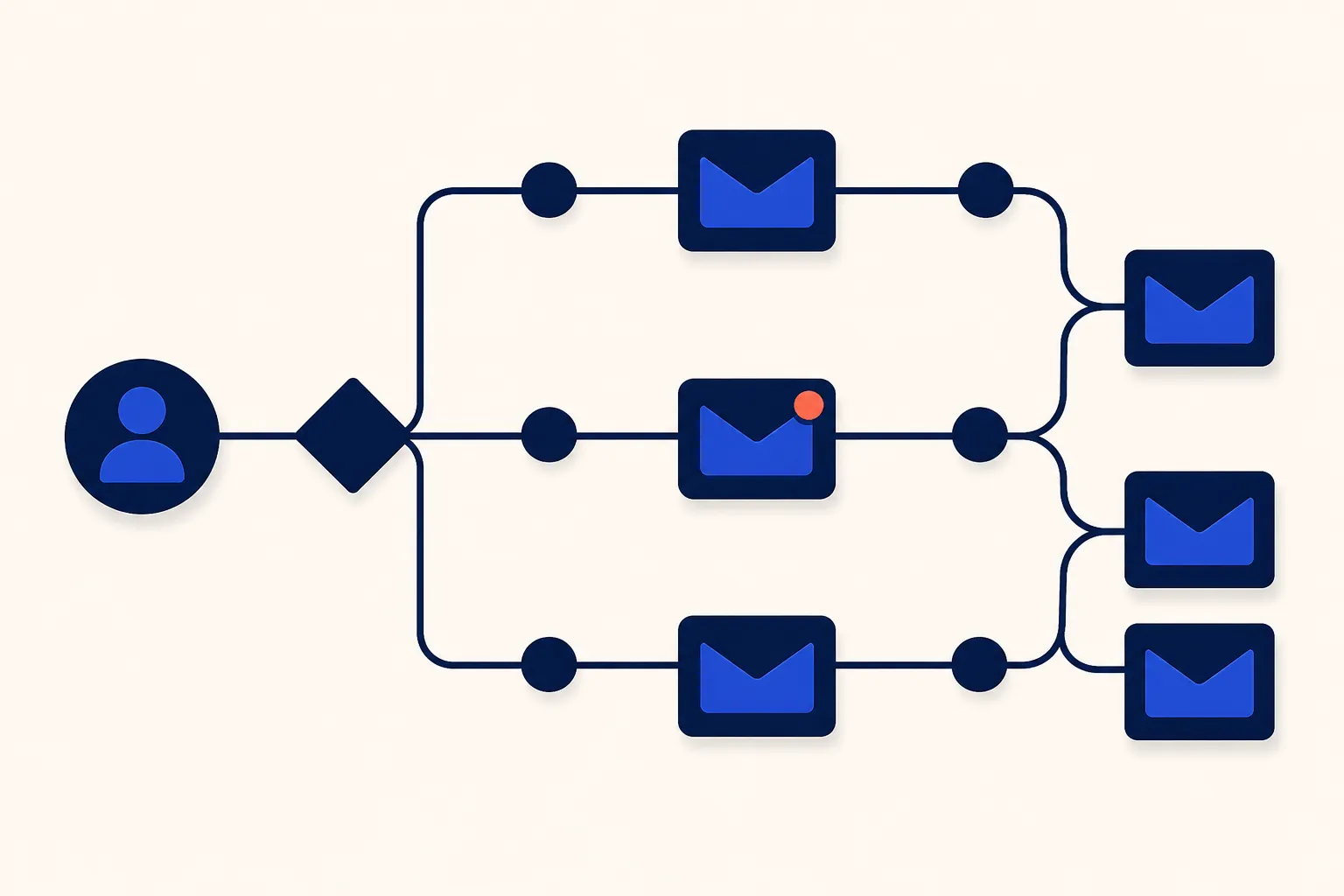
Customer.io was built around event-based messaging: trigger a workflow off a signup, an activation milestone, a skipped onboarding step, or a stretch of inactivity, across email, SMS, push, and in-app. That depth is real, and for many product-led teams it’s still the right tool. The friction shows up in three places.
Pricing at scale. Per Customer.io’s pricing page, Essentials covers up to 5,000 profiles and 1 million emails per month for $100/month. Once profile count or feature needs (HIPAA compliance, more object types, premium support) push you into Premium, pricing moves to custom quotes that commonly start near $1,000/month. For a growing SaaS product, profile count often outpaces email volume, so the bill grows even if actual send volume stays flat.
Setup overhead. Event tracking, segmentation logic, and workflow branching require real configuration, usually with engineering involved to instrument the events Customer.io needs. Teams without that bandwidth feel the learning curve immediately.
Tooling fragmentation. Customer.io handles lifecycle messaging but not templating or email automation infrastructure end to end. Teams that also want a developer-friendly API and template system in one platform end up running Customer.io next to a separate transactional tool.
None of this makes Customer.io a bad product. If your workflows are already built and your team is trained on it, switching cost usually outweighs what you’d gain from any of the options below.
Customer.io Alternatives at a Glance
| Tool | Best For | Pricing Signal | Free Tier |
|---|---|---|---|
| Braze | Enterprise cross-channel orchestration at scale | Custom, MAU + credit-based | No |
| Iterable | Mid-market/enterprise multichannel campaigns | Custom, MAU-based quote only | No |
| Encharge | Budget behavioral automation for B2B SaaS | From $99/mo (2,000 subscribers) | 14-day trial, no free tier |
| Loops | Early-stage SaaS needing lifecycle + transactional | From $49/mo (5,000 contacts) | Yes, 1,000 contacts |
| Brevo | Combined marketing + transactional sending | From $9/mo (Starter tier) | Yes, 300 emails/day |
| MailerLite | Simple automation on a tight budget | From $12/mo (Comfort plan) | Yes, 250 subscribers |
Pricing as of July 2026, per each vendor’s official pricing page.
Braze: Best for Enterprise Cross-Channel Orchestration
Braze is built for large organizations running coordinated campaigns across email, push, SMS, in-app messages, and WhatsApp from a single customer engagement platform. Per Braze’s pricing page, the platform offers four editions (Go, Select, Pro, and Enterprise) priced against monthly active users combined with a credit-based system for cross-channel sends and AI features. No dollar figures are published; every quote is custom.
The depth is real: audience segmentation, canvas-based journey building, and dedicated support tiers suited to teams with a dedicated lifecycle or CRM marketing function. That same depth is overkill, and often cost-prohibitive, for an early-stage SaaS team evaluating its first lifecycle tool.
Pick Braze if: you’re an established company needing unified orchestration across many channels and have the budget and team to manage a platform this large.
Iterable: Best for Mid-Market Multichannel Campaigns
Iterable occupies similar territory to Braze: multichannel campaign orchestration (email, SMS, push, in-app) with AI-assisted content and send-time features, aimed at mid-market and enterprise marketing teams. Iterable does not publish a public pricing page; per its contact-sales page, pricing is quote-based and scales with monthly active users and channel mix, arranged directly with sales.
Workflow canvas and segmentation tools are comparable in depth to Customer.io’s, with a broader channel set out of the box. The trade-off matches Braze’s: no self-serve trial, no transparent pricing, and a sales cycle before you know the cost.
Pick Iterable if: you need enterprise-grade multichannel orchestration and are already comparing it directly against Braze or Customer.io Premium.
Encharge: Best Budget Behavioral Automation for B2B SaaS
Encharge is purpose-built for B2B SaaS behavioral automation: a visual flow builder, segmentation by user and company attributes, and native integrations with Stripe, Segment, and (on the higher tier) HubSpot and Salesforce. Per Encharge’s pricing page, the Growth plan runs $99/month (or $79/month billed yearly) for up to 2,000 subscribers with flow-based automation and webhooks. Premium adds transactional email, CRM integrations, and custom objects for $159/month (or $129/month yearly) at the same subscriber count. Overages run $100 per additional 100,000 emails sent.
That entry price sits close to Customer.io’s $100/month floor, but Encharge’s subscriber cap is lower (2,000 versus Customer.io’s 5,000 profiles), so the comparison depends on your active user count more than sticker price.
Pick Encharge if: you want Customer.io-style behavioral triggers without the enterprise price jump, and your subscriber count fits comfortably under 2,000 for now.
Loops: Best for Early-Stage SaaS Needing Lifecycle and Transactional Together
Loops was built specifically for SaaS startups, combining transactional sending, product event-triggered automation, and marketing campaigns in one platform. Per Loops’s pricing page, the Free plan covers 1,000 subscribed contacts and 4,000 sends/month with every feature included. Paid plans start at $49/month for 5,000 contacts with unlimited sends, moving to $99/month around 10,000 contacts. Transactional sending is included at no extra charge across every tier.
The event-trigger model (fire a sequence off activation, onboarding progress, or inactivity) is closer to Customer.io’s approach than to a typical marketing tool, just at a fraction of the cost and complexity.
Pick Loops if: you’re an early-stage SaaS team that wants lifecycle and transactional email unified without Customer.io’s setup overhead or price floor.
Brevo: Best for Combining Marketing and Transactional in One Plan
Brevo’s angle is consolidation across marketing and transactional sending under one plan. Per Brevo’s pricing page, the Free plan includes 300 emails/day with no credit card required. Starter begins at $9/month for 5,000 emails/month but does not include marketing automation. Standard, Brevo’s most popular tier, starts at $18/month and adds automation workflows, A/B testing, and advanced reporting. Professional moves to sales-assisted pricing starting around 150,000 emails/month and adds WhatsApp, push, and AI-based segmentation.
Automation depth is real once you’re on Standard or above, but it’s list-and-campaign oriented rather than the deep behavioral event modeling Customer.io specializes in.
Pick Brevo if: you want marketing automation and transactional sending on one bill and don’t need Customer.io’s granular behavioral segmentation.
MailerLite: Best for Simple Automation on a Tight Budget
MailerLite is priced and built for straightforward email marketing rather than deep behavioral lifecycle messaging. Per MailerLite’s pricing page, the Free plan covers 250 subscribers, 2 user seats, and 2,500 monthly emails. Comfort starts at $12/month with 3 seats; Power starts at $25/month with unlimited seats, unlimited monthly emails, multiple automation triggers, and 24/7 live chat support. Enterprise pricing is custom for lists over 200,000 subscribers.
Automation on Power covers common triggers (signup, tag added, date-based), but it doesn’t match Customer.io’s event-based branching for complex, multi-condition sequences.
Pick MailerLite if: your automation needs are straightforward (welcome series, basic onboarding nudges) and cost matters more than behavioral depth.
Coldletter: Best for Developer Teams Wanting Templating, Automation, and Integration Together
Coldletter is built for SaaS teams that don’t want to run a separate templating tool, automation platform, and integration layer from three different vendors. The platform pairs a developer-friendly core (API, SDK, code-based templating) with a visual builder for automation flows, so a developer can own the integration while a growth marketer or PM owns the lifecycle sequences, in the same product.
It is not a direct match for Customer.io’s depth of behavioral segmentation and multichannel orchestration. Where it fits is the team currently stitching together a transactional API, a template builder, and a separate automation tool. Coldletter does not publish pricing publicly; contact the team for details.
Pick Coldletter if: templating, automation, and integration in one developer-friendly platform matters more to you than matching Customer.io’s full behavioral-messaging feature set.
How to Choose a Customer.io Alternative
Enterprise scale, many channels — Braze or Iterable, both quote-based and sales-assisted.
B2B SaaS behavioral automation on a budget — Encharge, the closest match to Customer.io’s trigger model at a fraction of the entry price, as long as your subscriber count stays under a couple thousand.
Early-stage SaaS, transactional and lifecycle in one — Loops, the lowest-friction way to get event-triggered sequences and transactional sending without a second vendor.
Marketing automation plus transactional on one bill — Brevo, once you’re on Standard or above.
Simple automation, cost-sensitive — MailerLite, if your sequences don’t need deep behavioral branching.
Templating, automation, and integration together — Coldletter.
Need transactional email only, not lifecycle automation? See our comparison of transactional email services for providers built around that single job.
Stay on Customer.io if: your workflows are already built, your team is trained on the platform, and the switching cost of rebuilding event tracking and segments outweighs what you’d save.
Frequently Asked Questions
What is the best Customer.io alternative for early-stage SaaS teams?
Loops or Encharge are the most practical starting points. Both offer event-triggered automation at a fraction of Customer.io’s $100/month entry price, without Braze or Iterable’s enterprise sales cycle. Loops starts at $49/month for 5,000 contacts with transactional sending included; Encharge starts at $99/month for 2,000 subscribers with B2B behavioral flows.
Are Braze and Iterable more expensive than Customer.io?
Generally, yes, though neither publishes list pricing so a direct comparison isn’t possible without a quote. Both price against monthly active users and typically target mid-market to enterprise budgets. They make sense once you need coordinated orchestration across many channels with a dedicated team to manage that complexity; Customer.io’s Essentials and Premium tiers cover a narrower channel set at a lower published starting price.
Why do SaaS teams switch away from Customer.io?
The most common reasons are pricing that scales with profile count rather than email volume (a jump from $100/month Essentials to custom Premium pricing near $1,000/month), the setup and event-tracking work required to get workflows running, and wanting templating, automation, and integration consolidated in one platform instead of a separate tool.
Is MailerLite a good replacement for Customer.io’s behavioral automation?
Not fully. MailerLite’s automation triggers (signup, tag added, date-based, and more on the Power plan) suit newsletters and simple onboarding sequences, but they don’t match Customer.io’s event-based branching for complex, multi-condition workflows. MailerLite is a reasonable fit if your automation needs stay straightforward; teams needing deep behavioral segmentation should look at Encharge, Loops, or Customer.io itself.
How does Loops or Encharge pricing compare to Customer.io?
Customer.io’s Essentials plan starts at $100/month for up to 5,000 profiles and 1 million emails. Loops starts at $49/month for 5,000 contacts with unlimited sends. Encharge starts at $99/month for 2,000 subscribers. Both alternatives cost less at the entry tier, but neither matches Customer.io’s segmentation and data-modeling depth once your active user base scales into the tens of thousands.
Can I migrate automation workflows directly from Customer.io to another platform?
No. There’s no one-click migration between customer messaging platforms. Event definitions, segments, and multi-step workflows need to be rebuilt manually, and behavioral event history typically doesn’t transfer. Contact and profile data usually exports as CSV. Plan to re-instrument event tracking, often through a CDP like Segment, before cutting traffic over to the new platform.

I’ve spent my career building software at scale with a soft spot for email: deliverability, lifecycle campaigns, and getting messages to actually land. I started Coldletter to fix what bugged me about transactional and marketing email tools. I’m based in Vancouver.